
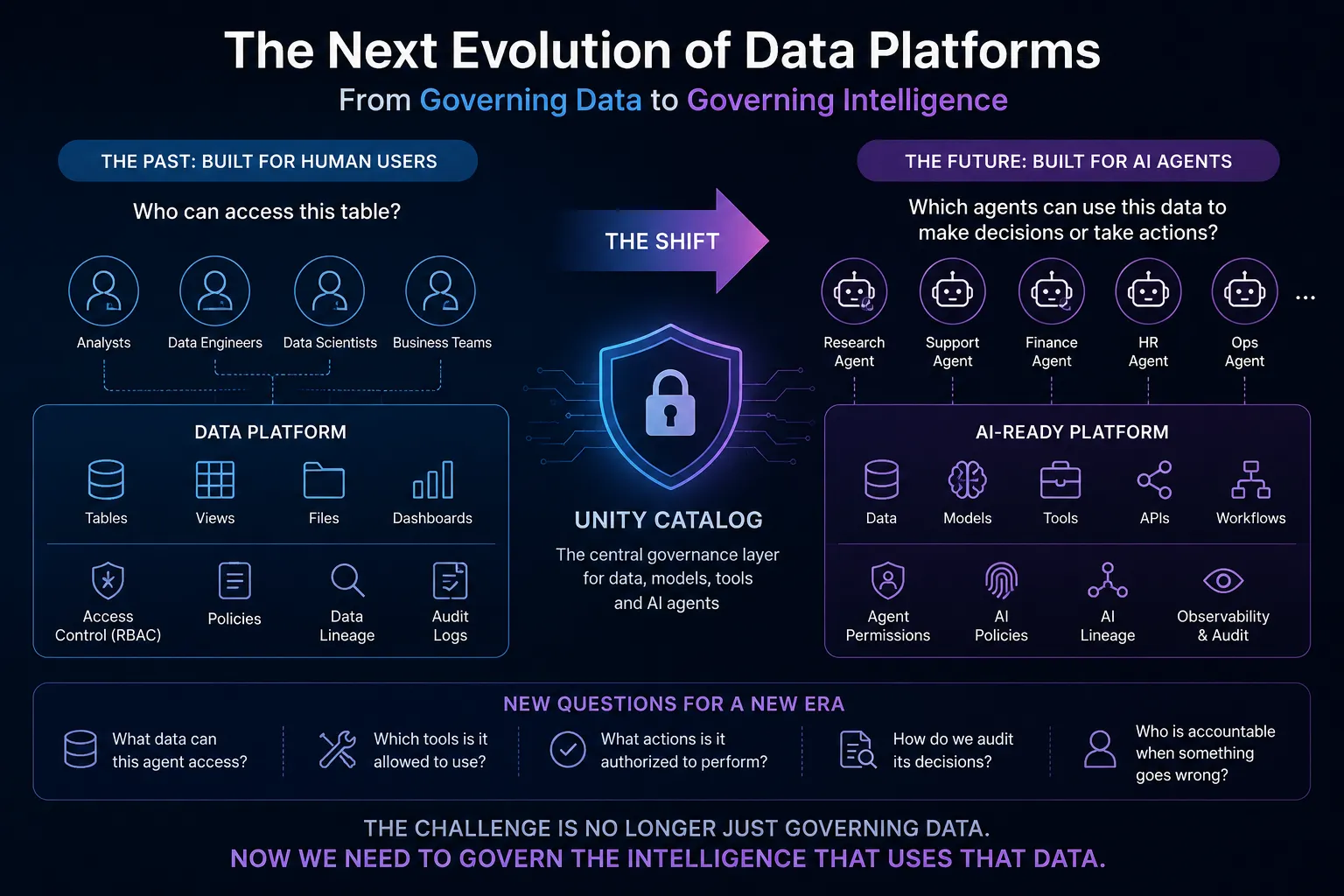
After reading Databricks' latest updates on Unity Catalog, I started wondering...
For years, the most important question in a data platform was simple:
Who can access this table?
The question is changing
With AI agents on the rise, that question is changing fast.
Now it's:
Which agents can use this data to make decisions or take actions?
A new phase of Data Engineering
We are entering a new phase of Data Engineering and Data Architecture: AI Governance.
Until now, most organizations have designed their data architectures for users such as:
• Analysts
• Data Engineers
• Data Scientists
• Business teams
But the next major consumer of your data platform probably won't be a person.
It will be an AI agent.
An agent capable of querying tables, combining information, calling APIs, executing workflows, opening tickets, generating reports, or even initiating business processes automatically.
New questions for AI-ready platforms
And that raises new questions:
What data can this agent access?
Which tools is it allowed to use?
What actions is it authorized to perform?
How do we audit its decisions?
Who is accountable when something goes wrong?
Concepts such as:
• AI Governance
• Agent Permissions
• AI Lineage
• Model Governance
• Data Policies
are becoming just as important as ETL, ELT, Data Quality, and Observability.
Unity Catalog as a governance layer
Recently, Databricks shared its vision for this challenge through the evolution of Unity Catalog.
The platform is no longer positioning Unity Catalog simply as a data catalog, but as a central governance layer for data, models, tools, and AI agents.
One of the biggest architectural shifts of the coming years may be this:
The challenge is no longer just governing data. Now we need to govern the intelligence that uses that data.
Are our architectures ready?
Are we ready to design architectures built for AI agents rather than just human users?
How is your organization preparing for AI Governance?
References and further reading
Original publication
This article was written by Rodrigo Póvoa and originally published on LinkedIn.